Showing posts with label locomotion. Show all posts

Sunday, 24 November 2013

Anthro leg structure 3

Following from the previous post... now that I know to turn Google image enhance off so that it stops turning all my images black...

Unguligrade legs on the left and digitigrade on the right.

Another way to think about the tapering limb as it becomes more distal is to think about 'muscular bulk', 'taper' and 'tendon'. We have the main muscle bulk at the origin of the limb, the muscle tapers down towards the tendon and finally terminates as just tendon onto the bone. This can be applied to any individual muscle of a limb (fig. 2) or also to the limb as a whole (fig. 1). Drawing a limb with this in mind ensures it stays in proportion.

The proportions of the limb are indicated by the measuring arrows. The set of legs on the left have a shorter thigh in proportion to the more distal, (further from the body) part of the limb; this limb configuration would offer the character the ability to run faster. As I touched on this in a previous post, a longer distal portion of the limb offers a greater stride distance and holds more elastic strain energy, quickening the limbs movement. The legs of the digitigrade on the right have a proportion of thigh to lower leg almost 1:1, similar to us as plantigrades. This would offer more limb stability rather than speed with the joints being less prone to stresses or twisting.

One thing to note is that the stability and speed configurations can apply to both digitigrades and unguligrades; it would simply be species and character dependent.

Sunday, 10 November 2013

Anthro leg structure 2

I was asked a few weeks ago to help with creating a set of satyr legs. The main point I outlined was:
only look at the biggest forms when filling out the wire frame with muscles. Keep the curves flowing; show the largest sweeps of these shapes to keep them dynamic; have them show the force of the muscles not just their outlines. Don’t get too hung up on individual muscles at the start, that detail is for later when you’re shading, make sure you’re drawing the big forms to start with.
Some ideas to consider on an unguiligrade biped leg.

Gesture: Centre top is an idea of the flowing curves for a digitigrade and unguligrade type. I wanted to get an idea of the fundamental shapes the curves make as if the legs were mechanical; they would be made of curves that would give them spring as they moved.
Form: On the left an idea of where the muscular bulk is as opposed to the bone and tendon areas. All limbs follow the principle that they get thinner the more distal (further from the torso) they become. Take the human arm as example, muscular bulk decreases further down the arm and the limb becomes more sinuous until we get down to just tendons controlling the hand and fingers. This decrease in muscular bulk is worth noting when drawing so as to keep the limb in proportion. On the right is this idea now shown as contours in the forms of the leg.
Function: At the bottom of the image is a movement sequence. Those areas shaded represent the major muscles that are contracting. The quadriceps, (Q) extend the knee just before the 'contact'. On the 'down', the limb is slowed by the hamstrings (H) as the limb takes the torso's full weight. The elastic energy in taking this weight is channelled down into to fetlock or toe joint by long flexor tendons. This energy is released in the 'up' with the gluteals (G) powering the knee to full extension and the hamstrings extending the hip. This drives the torso forwards as I've talked about in previous posts. Note that the 'knee' and the 'toe' joints flex and extend by the greatest degree, the 'ankle' joint is kept relativity stiff. If the ankle was allowed to flex too much the limb would collapse under the weight of the torso.


Tuesday, 29 October 2013

Anthro run cycle

... and now the wire frame for a possible run cycle. Here I've tried to oscillate both hips to reflect their full range of motion during this cycle. The timing isn't finely tuned yet, different moments of the cycle will create faster and slower points in each limbs movement which I haven't really maximised yet. Useful as a reminder that anthro movement is very energetic, likely the arms will have to be swung in arcs to maintain balance.

Ignore the black dots in the middle, they were placeholders for the start and finish of the cycle

Tuesday, 22 October 2013

Anthro walk cycle

A quick test of a wire frame I made of an anthro walk cycle. I think it's rather species neutral but I had a larger herbivore type in mind; not only is there rise and fall in the hips but due to the mass and stability issues of the legs, each step the leg is going to be thrown forward, creating a far amount of 'hip swagger'. This isn't efficient, as I've mentioned in previous posts, but a digitigrade or unguligrade on 2 legs isn't ever going to be.


Thursday, 13 June 2013

Stance sketches

Some ideas on digitigrade and ungiligrade legs this week. I'm hoping to have the time this month to complete some 2D animations on walking.

Friday, 10 May 2013

Standing upright - Part III


In Part I I looked at changes in pelvic configuration from early hominids. It’s useful to note these changes as it helps explain why we are good at being bipedal and conversely, what wouldn't work or work very well. I’ve laid out what I’ve found here in terms of adaptations to the pelvis from quadruped to biped, these can act as our ‘ground rules’ for consideration when designing anthro characters or mechanical walkers.

Points to consider:


  • Centre of gravity – bipeds must make sure their centre of gravity doesn't shift drastically from side to side with each step, this is destablising and inefficient.
  • A tall pelvis has the effect of lengthening the torso, meaning that the centre of gravity moves higher, further away from the hips. This makes the trunk harder to stabilise.
  • The ‘S’ curve of the lumbar vertebra lowers the centre of gravity towards the hips, helping stabilise the torso.
  • This lumbar curve also gives the vertebral column the flex needed to withstand the pressure of the torso acting through it, the lower lumbar have widened giving a larger surface area for weight transmission.
  • A wider sacrum has evolved to accommodate the wider lower lumbar vertebra. The sacroiliac joint (connecting the sacrum and the pelvis) also has a large surface area for weight transmission from the torso through both sides of the pelvis down to the femoral heads.
  • The widened sacrum increases the width of the 'true pelvis', (the space through the centre of the pelvis), facilitating the ability to birth offspring with much larger craniums.
  • However, a wider pelvis is a problem. During the support phase of locomotion one leg is off the ground. The weight of the torso is now acting on the femoral head of the standing leg. This is an example of a first class lever (levers that balance weight like a child's see-saw). The femoral head is acting as the pivot and the distance from the pivot to the body weight is called the 'load arm'. The ‘force arm’ on the other side of the pivot is our gluteus medius (an abductor muscle). It contracts to counterbalance the load arm. The wider we make our pelvis the longer we make the load arm, putting more pressure on the femoral head. We need a larger force or longer force arm to increase the mechanical advantage of this lever, otherwise we risk damaging the femoral head or having the hips slump with each step, just like the chimpanzee. In the Lucy skeleton, Australopithecus afarensis, it reveals her long load arm was countered by an increased length in the neck of the femur and a flaring of the iliac crest of the pelvis to place the abductors further from the pivot.
  • The bicondylar angle is unique in humans. The femurs converge at the knees, bringing the legs close to the midline. This means the feet pass close to the midline and the centre of gravity is maintained directly underneath the torso. This is energy efficient as it doesn’t create a side to side motion of the hips when we walk.

Thursday, 9 May 2013

Standing upright - Part II


It isn’t possible to directly compare a set of quadruped ‘buttocks’ to that of a human because for quadrupeds, like the horse in this example, their behinds are not really gluteals, they are hamstrings. I'll bang on about these muscles groups just once more:

Hamstrings: in quadrupeds serve as powerful hip extensors, driving the animal forwards against the ground reaction and pulling the leg up and backwards to take the next stride, whereas in humans their action is similar but less powerful due to them being almost vertical when stood upright. Importantly, in bipeds they counteract the truck from falling forward.

Gluteals: in a quadruped, are powerful locomotors also extending the hip, in humans these would relate to gluteus minimus and medius and are now adapted to stabilise the hip laterally, most notably when we stand with one leg off the ground, rather than being used for locomotion. In bipeds the gluteus maximus takes more of the role of hip extensor via the ilio-tibial band. Gluteus maximus also counteracts the truck from falling forward.


Take a look at the action of the race horses legs, you can see all that ground force coming from the contraction of the hamstrings at the back and gluteals at the top of the hind limb pulling them backwards and driving the horse forwards. 


The gluteus maximus dominates in humans, its function still makes it a powerful hip extensor but it’s role in stabilising, holding the femur and pelvis in alignment, keeps us stood upright. This makes it a very important muscle for bipeds. (Also worth noting that a large gluteal makes it easier for us to sit down).

Dependent on your furry character’s needs, be them straight legged or bent kneed, their gluteals and hamstrings are going to function slightly differently, be sized accordingly and maybe even positioned differently. All that is going to be aided by the configuration of their pelvis.

Monday, 29 April 2013

Standing upright - Part I


Bipedalism in Humans is by no means a well evolved task. We still have issues of lower back pain, knee joint stresses, ankle injuries and hip fractures. Many of these aliments are conditions of aging but it shows during our life time where we are taking the stresses and risks of standing upright.

When we discovered the skeletal remains of Australopithecus afarensis commonly known as ‘Lucy’, we had proof that bipedal hominids were around 3.5million years ago. When we look at her pelvis we can see more in common with our species than that of our distant relations like chimpanzees who are better adapted to climbing and quadruped walking. Lucy’s anatomy showed us that moving from quadruped to biped relied on a reconfiguration of the bony plains of the pelvis and the function of some locomotor muscles to provide lateral support while walking.

The ilia of most quadrupeds are thin and flat to the back of the torso, a gradual bending of these has formed the bony rounded ridge of the iliac crests, giving an anchor point for muscles bearing lateral support, very important for stabilising the hip of a biped.


This video is taken from the BBC’s ‘Prehistoric Autopsy’ Series. You can clearly see how similar Lucy walks compared to modern humans. In contrast the Chimpanzee on the right does not have the required skeletal and muscular configuration of its hip to allow it to walk effectively on two legs.

Pelvic configuration in humans has slowly adapted to provide quite a host of requirements: the most advantageous configuration of musculature for locomotion, transfer of weight during locomotion and to hold the torso upright during locomotion, along with providing the space to adequately hold the internal viscera, and importantly, the birthing passage for offspring. Because of the above, I feel that the pelvis is one of those areas that is quite pivotal in considering an anthro characters design. Without having to delve too deep into bio-mechanics  it’s good to take a look at some of the requirements needed to make a pelvis fit our characters given needs to see what ‘rules’ we may need to follow when making them more anthropomorphic. 

Sunday, 14 April 2013

Walking on 2 legs not 4 - Stride and energy

So what would make X-Men's Beast run faster than a human? Well there are a couple simple things that we can observe from those animals that can easily outrun us. Firstly, as a biped plantigrade our maximum stride length is really rather short, a longer stride covers more ground and generally makes a faster runner. (What could break that rule would be an elephant, a plantigrade, that moves it's legs very fast when it charges). 

Digitigrades like a cheetah and unguligrades such as horses have a stride advantage by having longer limbs distal from what would be the knee joint. Simply a lengthening of the metatarsals.
The length of the femurs represented above are equal in length across the different classes for comparison.
That's an advantageous change in bone configuration but driving the power is a muscular change. Secondly, animals like horses have short fibred muscles on their lower limbs that attach to long tendons for elastic energy storage. This increased spring creates a mechanical advantage in the limb, meaning the muscles become more economical as they do not need to generate as much force per stride.

Check out just how thin the lower leg is on a horse, those long tendons and the canon bone are really the only thing they've got; there's no muscle. Find more plates like this Here.

This video is taken from "Inside Nature's Giants - The Race Horse" - (Channel 4). It's a dramatic example of just how much force is stored in the tendons once they are under stress. Energy that would otherwise be lost is recovered via this elastic strain energy. This would make Beast's flat hand very energy inefficient whilst running, and even the bony arch of the human foot is rather inflexible and still a long way from holding the capacity of elastic strain of even a digitigrade.

So if you were designing a character that's a serious fast runner - biological or mech, you might want to give them a shorter thigh in relation to the lower leg to extend that stride and go easy on the musculature of the lower leg, giant muscles don't always create giant forces, that depends on their position on the limb in terms of leverage! Of course, these are not the only things to consider for a set of biped digitigrade legs...

Thursday, 11 April 2013

Walking on 2 legs not 4 - Feet

This scene in X-Men First Class raised a brow when I first saw it. In it, Beast out runs Xavier.


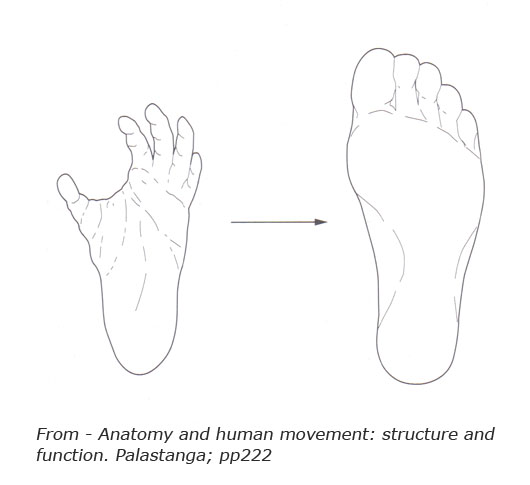
What's been assumed here is that because Beast has hands for feet, he's better and faster at running than a human. Is that a correct assumption? Likely not, as it insinuates that the primate 'foot' is more adapted for running than a human foot.


The diagram above is pretty much representative of the anatomy that's at contest in the film. A chimpanzee's foot is a generalised appendage (gripping, climbing, walking, standing), the human foot has evolved into that of a specialised appendage for bipedal locomotion. We have a bony foot arch that allows for spring and the transmission of huge forces when we walk, making it more energy efficient. It is more adapted to forward propulsion and aids our gait, than that of a flat, figured hand of a chimp. Far from being faster, Beast would most likely injure himself trying to compete against human feet.