Showing posts with label evolution. Show all posts

Friday, 10 May 2013

Standing upright - Part III


In Part I I looked at changes in pelvic configuration from early hominids. It’s useful to note these changes as it helps explain why we are good at being bipedal and conversely, what wouldn't work or work very well. I’ve laid out what I’ve found here in terms of adaptations to the pelvis from quadruped to biped, these can act as our ‘ground rules’ for consideration when designing anthro characters or mechanical walkers.

Points to consider:


  • Centre of gravity – bipeds must make sure their centre of gravity doesn't shift drastically from side to side with each step, this is destablising and inefficient.
  • A tall pelvis has the effect of lengthening the torso, meaning that the centre of gravity moves higher, further away from the hips. This makes the trunk harder to stabilise.
  • The ‘S’ curve of the lumbar vertebra lowers the centre of gravity towards the hips, helping stabilise the torso.
  • This lumbar curve also gives the vertebral column the flex needed to withstand the pressure of the torso acting through it, the lower lumbar have widened giving a larger surface area for weight transmission.
  • A wider sacrum has evolved to accommodate the wider lower lumbar vertebra. The sacroiliac joint (connecting the sacrum and the pelvis) also has a large surface area for weight transmission from the torso through both sides of the pelvis down to the femoral heads.
  • The widened sacrum increases the width of the 'true pelvis', (the space through the centre of the pelvis), facilitating the ability to birth offspring with much larger craniums.
  • However, a wider pelvis is a problem. During the support phase of locomotion one leg is off the ground. The weight of the torso is now acting on the femoral head of the standing leg. This is an example of a first class lever (levers that balance weight like a child's see-saw). The femoral head is acting as the pivot and the distance from the pivot to the body weight is called the 'load arm'. The ‘force arm’ on the other side of the pivot is our gluteus medius (an abductor muscle). It contracts to counterbalance the load arm. The wider we make our pelvis the longer we make the load arm, putting more pressure on the femoral head. We need a larger force or longer force arm to increase the mechanical advantage of this lever, otherwise we risk damaging the femoral head or having the hips slump with each step, just like the chimpanzee. In the Lucy skeleton, Australopithecus afarensis, it reveals her long load arm was countered by an increased length in the neck of the femur and a flaring of the iliac crest of the pelvis to place the abductors further from the pivot.
  • The bicondylar angle is unique in humans. The femurs converge at the knees, bringing the legs close to the midline. This means the feet pass close to the midline and the centre of gravity is maintained directly underneath the torso. This is energy efficient as it doesn’t create a side to side motion of the hips when we walk.

Monday, 29 April 2013

Standing upright - Part I


Bipedalism in Humans is by no means a well evolved task. We still have issues of lower back pain, knee joint stresses, ankle injuries and hip fractures. Many of these aliments are conditions of aging but it shows during our life time where we are taking the stresses and risks of standing upright.

When we discovered the skeletal remains of Australopithecus afarensis commonly known as ‘Lucy’, we had proof that bipedal hominids were around 3.5million years ago. When we look at her pelvis we can see more in common with our species than that of our distant relations like chimpanzees who are better adapted to climbing and quadruped walking. Lucy’s anatomy showed us that moving from quadruped to biped relied on a reconfiguration of the bony plains of the pelvis and the function of some locomotor muscles to provide lateral support while walking.

The ilia of most quadrupeds are thin and flat to the back of the torso, a gradual bending of these has formed the bony rounded ridge of the iliac crests, giving an anchor point for muscles bearing lateral support, very important for stabilising the hip of a biped.


This video is taken from the BBC’s ‘Prehistoric Autopsy’ Series. You can clearly see how similar Lucy walks compared to modern humans. In contrast the Chimpanzee on the right does not have the required skeletal and muscular configuration of its hip to allow it to walk effectively on two legs.

Pelvic configuration in humans has slowly adapted to provide quite a host of requirements: the most advantageous configuration of musculature for locomotion, transfer of weight during locomotion and to hold the torso upright during locomotion, along with providing the space to adequately hold the internal viscera, and importantly, the birthing passage for offspring. Because of the above, I feel that the pelvis is one of those areas that is quite pivotal in considering an anthro characters design. Without having to delve too deep into bio-mechanics  it’s good to take a look at some of the requirements needed to make a pelvis fit our characters given needs to see what ‘rules’ we may need to follow when making them more anthropomorphic. 

Thursday, 11 April 2013

Walking on 2 legs not 4 - Feet

This scene in X-Men First Class raised a brow when I first saw it. In it, Beast out runs Xavier.


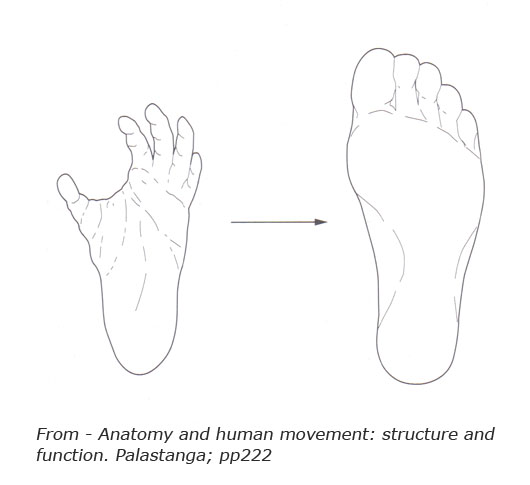
What's been assumed here is that because Beast has hands for feet, he's better and faster at running than a human. Is that a correct assumption? Likely not, as it insinuates that the primate 'foot' is more adapted for running than a human foot.


The diagram above is pretty much representative of the anatomy that's at contest in the film. A chimpanzee's foot is a generalised appendage (gripping, climbing, walking, standing), the human foot has evolved into that of a specialised appendage for bipedal locomotion. We have a bony foot arch that allows for spring and the transmission of huge forces when we walk, making it more energy efficient. It is more adapted to forward propulsion and aids our gait, than that of a flat, figured hand of a chimp. Far from being faster, Beast would most likely injure himself trying to compete against human feet.